This is going to be a bit of a love letter, so please excuse my enthusiastic rambling. <3
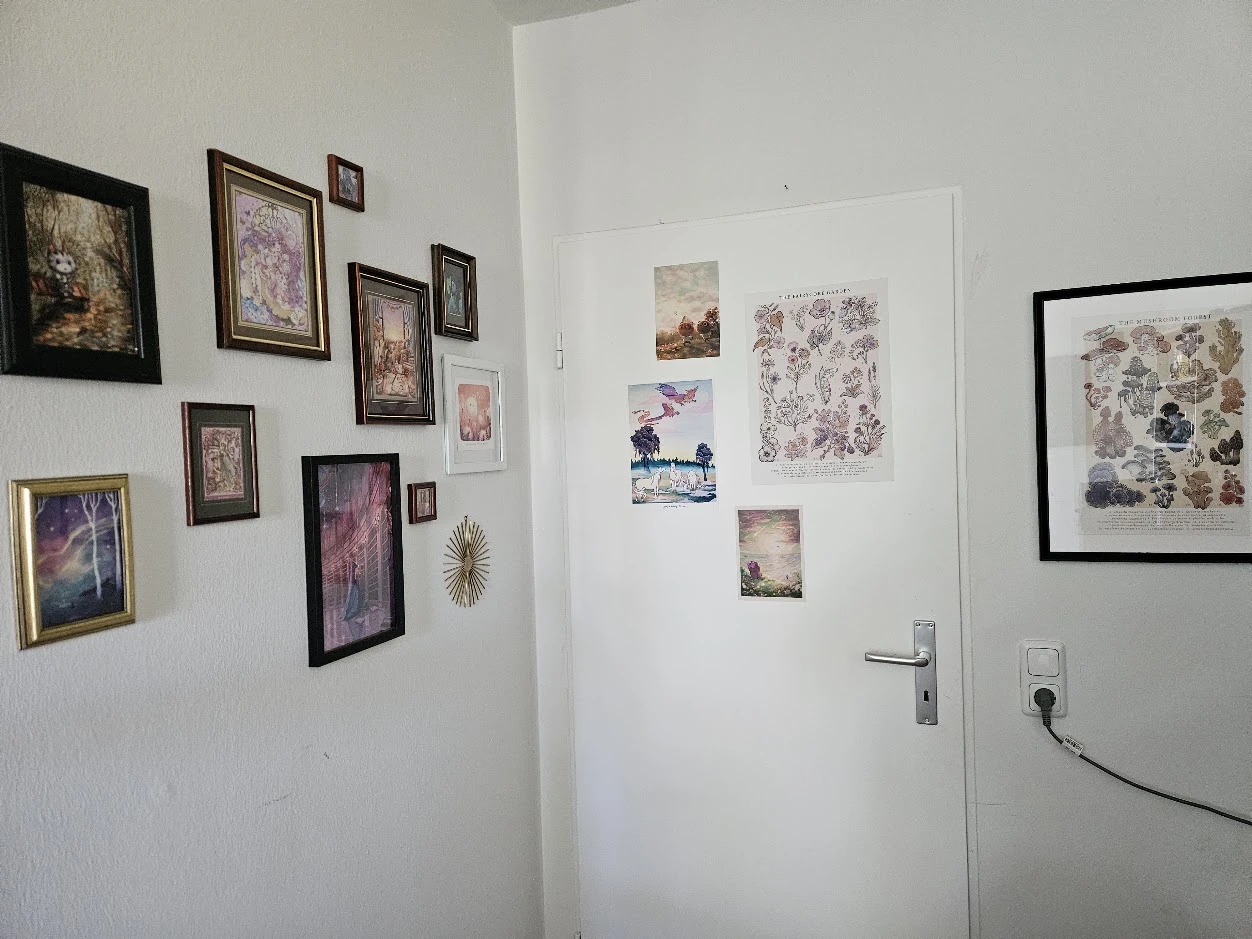
Where do you buy your art? Do you order it online? Maybe from an Instagram artist you love and adore? Perhaps from an affordable website, already curated and tagged with a popular aesthetic? Maybe you go to IKEA and buy a set of ready-made prints that fit the displayed frames and furniture perfectly. Maybe you even go to art galleries or museums and get prints from their respective stores.
Whatever you do, I’d bet you’ve already heard of, and maybe even bought something from, the artist alley.
This isn’t meant to tell you what to do, nor to claim that one method is better than another. Personally, however, I’m an avid and devoted artist alley enthusiast, and today I’ll tell you why I find the artist alley to be one of the last true refuges for small, independent art and the people who love it.
One Algorithm to Poison Them All
The number one enemy of small niches and casual art enjoyers to this day: the dreaded social media algorithm.
Not that it doesn’t show us exactly what we want to see. No, actually, it’s often so spot-on that it becomes the entire problem. Big artists tend to perform well across the board, no matter whether they’re actually making what you want or need to see.
Generally, an algorithm is going to show you what you’re likely to enjoy. Not more, nor less. But that… it just renders everything so grey.
It’s taken me ages to find more than the very small handful of super popular art channels on Instagram. And it’s not even just that. Between all the super high-attention-grabbing content, a simple artwork, no matter how well made, just isn’t going to show up that much.
Social media is, like, okay-ish. But honestly, I don’t think I’m even being shown a fraction, a sliver even, of what I want to see. And part of it is my fault. I’m just so susceptible to the pull of virality and short-form content.
Instagram and similar platforms aren’t where I go to find art anymore, even if I’d like them to be. My filter bubble has filtered out all the goodness and left my feed feeling empty and hollow at times.
Art Is So Much More Than the Sum of Its Brushstrokes
Nothing compares to the real thing.
A screen could never show the shimmer of gold foil inlay in a highly contrasted piece of art. The small window through which we look at art most of the time just can’t convey what it’s like to stand in front of a majestic two-meter poster of an intricate painting. Nor could anything replace the experience of looking at the texture of paint and paper when you’re standing in front of an original.
Don’t get me wrong. Many people are amazing at photographing their art, and sometimes a good digital display can capture the colors of a digital artwork just as well as, or even better than, a print.
But having the art right in front of you, in numerous sizes and on different canvases and prints, really is something else.
Most of the time, I don’t even take as much care looking at a painting I find online. I just skim over it. When I’m standing right in front of it, large and beautifully displayed, it’s a completely different experience. It allows me to take everything in, down to the smallest detail.
I also really enjoy the displays and curation, and I personally believe they’re somewhat part of the artist’s creativity. The art is curated, displayed, and made part of a whole. A feed just shows uploads in chronological order, streamlined and presented in the same, quite small format.
And how are we even supposed to know what size to choose for a print if we haven’t seen it in real life yet?
That’s something irreplaceable to me.
Artists Are People
Did you know? You can talk to them! Meet them, hear about their ideas and visions!
There’s often a hundred times more to an artwork than meets the eye at first. Having the artist, or someone who knows the art well, right there to talk to is such a privilege. It makes a colorful page become something more.
I’ve been so lucky to have many amazing interactions with the loveliest artists at convention alleys, and I genuinely think they’re amazing people. Beyond their talent, I’ve been met with kindness, intelligence, passion, and inspiration when talking to artists about their work.
And let’s be honest. It’s not just about the art. It’s about who you support and whose inner world, displayed on a canvas or print, resonates with you.
What better way to get to know your art than to talk to its creator?
Oh, and by the way, if you’re into art or are an artist yourself, networking is a thing, and it’s much better done in person than over a dusty old Twitter DM or business email address.
Going to the Museum
There’s a tale that tells of a fellow who went to an artist alley and didn’t buy a thing. Yet he left full of dreams, hope, and brightness in his eyes.
That, of course, is a total myth. No one could leave an artist alley without buying anything if they still have a dime of allowance left for the month.
The intended message I wanted to convey: an artist alley is an experience.
Going to a museum or art gallery is quite a rare occurrence for me. Especially in my surroundings, I don’t get the feeling that many people still take the time to attend events like these, just idly looking at art for hours on end.
My artist alley trips compensate for that a little.
I don’t have to buy everything to enjoy, love, or be moved or inspired by the artwork. Most of what I take in, I don’t take home. I still feel that it does something to me. It’s more than just window shopping.
Many of my trips have left me feeling connected and moved. I’ve had the feeling that I was walking through worlds of wonder.
So I guess what I’m trying to convey is that an artist alley is also an experience. An event in its own right that can make me, at least, very happy!
The Glory of Curation
Ever wonder why artist alleys at good conventions rarely have much low-quality art or shoddy craftsmanship?
Well, lemme tell you something. There are actual people choosing from applications, sorting through presumably huge piles of AI-generated slop that you might never be able to distinguish from genuine art online. These people do the hard work of researching and curating the alleys for you.
While it might, of course, be a hurdle for some smaller, less accomplished artists to get through the selection process, I actually think that can be a good thing for both sides.
In the end, curators usually have a pretty good idea of what is likely to sell at all. They do their best to ensure vendors won’t lose too much money at an alley and will hopefully turn a pretty penny instead.
This mostly applies to the better-known locations, of course, but I still think it’s worth giving some serious consideration to whether selling at an artist alley is a good idea for you as an artist.
Whoever gets to be there will likely make at least some sales and gain a very different kind of exposure, too. And the people attending get to enjoy a hand-selected, high-quality collection of great artists.
Especially on Pinterest, I find it so hard to navigate through more slop than anything worthwhile. That’s why it makes me so happy to see actual, real art concentrated in one place.
So, Why Do We Need Artist Alleys?
We need artist alleys to see and experience real art by real people.
We have to be shown things we like and things we don’t like. We have to interact with art and its creators to discover the insane stories that helped shape what we’re looking at. We have to allow ourselves to marvel, to be impressed, to feel something physical, and to feel like we’re part of a community.
Because that’s what we are.
A community of people who love. Truly love art.